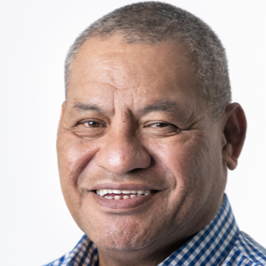
Former detective TeUraura Nganeko wants justice for his son Daniel (inset), who was killed by a coward punch thrown by Daytona Thompson.
Former detective TeUraura Nganeko wants justice for his son Daniel (inset), who was killed by a coward punch thrown by Daytona Thompson.
A former police detective whose son was killed by a coward punch says the real problem is not just sentencing but how fatal violence is investigated by police.
TeUraura Nganeko believes the underlying system architecture and Sentencing Act framework shape and often limit the outcome long before a case reachescourt.
“Police conducted a thorough investigation and are satisfied with its outcome,” Parnell told the Herald.
Daniel Nganeko died on July 29, 2025, three days after he was punched by Daytona Thompson – who then filmed his victim on the ground – outside a Taranaki rugby club.
TeUraura Nganeko says he believes that what happened in his son’s case reflects a deeper structural issue.
In reflecting on where justice is served, Nganeko told the Herald: “It is largely determined by police. Not the judges, not the courts, not Corrections.
Daytona Thompson was sentenced in the High Court at New Plymouth for the manslaughter of Daniel Nganeko. Photo / NZME
“Police control the investigation. They decide what evidence is gathered, what is pursued, and what is left out. They shape the entire evidential record that everyone else must then work from.
“In Daniel’s case, it was treated early as an unfortunate event between two young men, which is BS.
Daniel Nganeko's father, TeUraura Nganeko (right), was at the High Court hearing in New Plymouth.
“The first detective sergeant I spoke to said he felt sorry for both young men, both whānau, as if this was just a mistake, an unfortunate accident.
“And from that point, the investigation followed that narrative.”
But Parnell disagrees.
“Police conduct extensive investigations to ensure all possible lines of inquiry are investigated, no matter the incident,” the assistant commissioner said.
“This is to ensure there is enough evidence for potential court proceedings, and for the courts to make an informed decision for sentencing.
“As per the Solicitor General’s prosecution guidelines, any prosecution is required to meet an evidential sufficiency test.
“In this case, police laid a manslaughter charge after consulting with the Crown Solicitor.
“We understand incidents like this have life-changing effects to victims’ families, and our thoughts are with them as they go through this difficult time.”
Coward-punch crimes were back in the news last month when Parliament’s justice select committee heard submissions as MPs consider legislative changes to the Crimes Amendment Bill.
The bill includes three new offences for coward-punch crimes for head/neck strikes and proving intent.
Nganeko – who said he carried out his own investigation into the tragedy – believes that early framing of his son’s investigation dictated everything that followed; including upgrading the charge to manslaughter, but not murder.
“My investigation shows the offender had to be pushed away from Daniel earlier that night. He [Daniel] was targeted, pursued, and deliberately attacked,” Ngakeno claimed.
“If you minimise seriousness at the investigation stage, you limit what can be proven later.
“That affects the charge. It affects what the Crown can run. It affects what a judge can sentence.”
We talk about judges being too soft, or sentences being too low. But judges can only sentence on the facts put before them
“That is how outcomes are shaped upstream, with the police.”
As a former detective, he says, he understands exactly how the system works.
“As a father, I live with what that system delivered.
“The father in me feels the loss of my boy. The detective in me understands how it happened.
“And that is why I will keep pushing for change.”
Daniel Nganeko’s whānau and friends gathered at the New Plymouth Courthouse to hear the sentence handed down to Daytona Thompson, who delivered the punch that took Daniel’s life last winter.
Daniel Nganeko is one of 15 people the Sensible Sentencing Trust says have been killed by coward punches over the past 15 years.
Others include:
October 2024 Luke Smith
Luke Smith died after being coward punched by Siale Siale (inset) during a night out on Wellington's Courtenay Place. Composite photo RNZ Pool / Supplied
Siale Siale pleaded guilty to manslaughter over the death of South African Luke Smith in the early hours of October 2024 and was sentenced to two years and three months in prison.
Siale coward-punched Smith outside Wellington’s old Reading Cinema building. Smith fell backwards, hitting his head on the road. Siale kicked Smith in the groin, swore at him and filmed him on his phone as he lay unconscious and bleeding on the pavement.
Kahi wrongly believed Singh was trying to kidnap his son. On appeal, his sentence was reduced to 11 months of home detention.
Daniel Havili, who threw the punch that killed Fau Vake, was sentenced to two years and nine months in jail but was released after 11 months. Photo / Michael Craig
Vake hit his head on the concrete after Havili hit him with a coward punch, causing a brain bleed that led to Vake’s death nine days later. Havili was released after 11 months in prison.
Levi Haami, killed by a punch at a carpark gathering, was described by his family as "a beautiful, kind soul".
Unasa punched 60-year-old Goffe, who fell backwards on to a concrete driveway, hitting his head. He was taken to hospital and put on life support, but died five days later from his injuries.
Maka was sentenced to three years and eight months in prison and spent 15 months incarcerated.
April 2019 Jerico Telea
Joseph Larson pleaded guilty to the manslaughter of Jerico Telea, who was left in a critical condition after a serious assault near the intersection of Queen St and Vulcan Lane during the early hours of April 20, 2019. Telea, 24, died in hospital two days later.
Larson was sentenced to one year of home detention.
Kit John Murray was convicted of manslaughter and jailed for five years after he coward-punched Billy Dawson, 34, outside Auckland’s Spy Bar at the Viaduct during the Rugby World Cup in 2011.
Murray appealed against the sentence, saying it was too harsh and the assault had not involved “extreme violence”, but his appeal was turned down and he spent 20 months in prison.
August 2011 Felipe Sipaia
Jonathan Ioata was sentenced to four years and nine months in prison for the manslaughter of Felipe Sipaia, a 24-year-old father of three.
Sipaia died in Wellington Hospital in August 2011 after the assault.
Ioata spent 19 months in prison, and Sipaia’s wife forgave Ioata for killing her husband.
He was jailed for three years for manslaughter and spent 12 months behind bars.
Joseph Los’e joined NZME in 2022 as kaupapa Māori editor. Los’e was a chief reporter, news director at the Sunday News newspaper covering crime, justice and sport. He was also editor of the NZ Truth and worked for urban Māori organisation Whānau Waipareira.