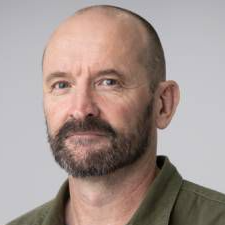
For a person who worked for years in an industry telling stories of all sorts – politicians, celebrities, the common person as well as the desperate, debauched and deserving – Oxenham gave little away.
That is, until the end, when he finally succumbed to his cancer.
At his own funeral, Oxenham shone on the large screen in black and white, well-lit of course and ripe with humour, gave his own eulogy.
“Jerry Seinfeld once noted that on a list of people’s greatest fears, number two was dying, number one is public speaking.
“So, if you’re at a funeral, you’d rather be in the casket than doing the eulogy.”
Oxenham was also typically humble.
“It’s pretty indulgent to write your own eulogy. But in lots of ways it’s been quite cathartic for me. So here we go. This is my story.”
Members of a cultural group from Nauru Secondary School prepare to perform at the opening ceremony of the Pacific Islands Forum in Nauru, 2018. Photo / Jason Oxenham
A few years back in the New Zealand Herald newsroom, tucked away where creatives could find some peace, Oxenham and fellow photojournalist Michael Craig started Book Club Fridays.
The idea was to swap photography books, then chat about the contents over the next week, Craig said.
Those exchanges showed Oxenham was an encyclopaedia of New Zealand press photography.
“He was a photographer because he loved the craft, the art of taking an image,” Craig said.
The best testament of his talent was from the people Oxenham captured in his frame, Craig said.
“So many times I’ve gone to take a photo of someone who has said to me, ‘Do you know Jason? He photographed me years ago. It’s still the best photo of me ever.’”
At 21, Oxenham reckoned he was a late starter studying the craft of photography at Carrington Polytech (later becoming Unitec).
In his final year, he told the head of the photography department he wished to focus on photojournalism. She announced to the class that he should leave the course and read a book about it at home.
“Spite to prove her wrong provided a huge motivation,” he said.
“The spite provided a fuel to work twice as hard as the other students.”
He finished that year with the top mark.
The faces of Armageddon, Labour Weekend, 2019. Photo / Jason Oxenham
Press photography can be a hard gig to crack into – it’s a cool job, so news shooters tend to stick around.
After finishing his course, Oxenham pumped gas for a year before securing a six-month contract at the Nelson Evening Mail.
He was on his way.
Back in Auckland, he was quickly picked up by Suburban Newspapers, and later spent more than a decade at the Herald. He also freelanced for major agencies.
The work took him around the world. He photographed Prime Ministers and All Blacks, an NRL final, a Rugby World Cup final.
He worked at Eden Park so often his kids thought he had an office there.
Swimmers cool off by jumping into the sea at the Murrays Bay jetty on Auckland's North Shore. Photo / Jason Oxenham
His ability to put people at ease in front of the lens was well known among reporters who worked with him.
He listened and read the room, and he was also respectful to anyone, whether they were a feisty gang member or a grieving mother, Herald investigative reporter Carolyne Meng-Yee said.
Oxenham had a large frame and cut an imposing figure. Being quiet, he could be read as gruff, she said.
That burly frame meant the former rugby player often got sent on jobs that might turn ugly. He went, but it wasn’t his natural territory.
“Jason would just have a stare, just look at them, and they’d back down. But really, he was a softy. He had heart,” Meng-Yee said.
“Jason wasn’t just point and shoot; he was very intelligent, very deep. He had a lot of EQ.
“He was a brilliant photojournalist because he captured real emotion in a photo.”
Broadcaster and author Stacey Morrison for Canvas, 2019. Photo / Jason Oxenham.
But Oxenham could be fierce when it mattered, like standing up for young reporters working under what he saw as unreasonable expectations.
“He’d punch up, and it was never about him,” Craig said.
“People sometimes have a moan, but his moans would be in support of somebody else rather than about him.”
Maybe he punched up because, as a boy, no one had punched up for him.
In his eulogy, Oxenham described himself as “a very lonely wee chappy growing up – a latchkey kid”.
His parents split when he was small. He was an only child, raised in Sandringham by his mother Judi, who somehow paid off the mortgage and kept food on the table on her own.
He came home from school each day and waited for her to get home at 5.30pm.
“It was just me and Mum against the world,” he said.
“We didn’t have much, but we didn’t want for much either. We had our own little tiny family unit.”
A teacher once told him, when he was about 13, that he was like a turtle whose head would rarely leave its shell.
That shy boy would, decades later, fall in love with someone who had grown up in much the same way.
Kristy Heinz was raised by a solo mother from the age of 7.
“It’s like he sees everything in a frame – he sees things that we don’t,” Kristy said.
He documented everything – family moments and triumphs, holidays and experiences.
Twenty photo albums sit on a shelf in the family home, year by year, assembled from print orders he’d put in every few months.
Ironically, he’s barely in any of them, Kristy said.
“He was the one behind the camera.”
To Jemma, he was the one in her corner and also the dad with the questionable dance moves, the one making everyone giggle. He was a bloody legend.
For Holly, he was father dearest, Jace the ace, her fellow blue-eyed kid, her favourite karaoke partner, her world, her everything.
When Ruby, their youngest, got the worst, “choppiest” bangs in Year 7, she bawled and refused to step outside ever again.
It was Dad who lay on the bed beside her, joking about all his own cowlick-caused bad hair days and the tape-cut bangs his mother had given him as a boy.
“He comforted me so much with his laughter and promises of hair growing out once again,” Ruby said.
There was a lot of fun and love in the Oxenham household.
And Kristy, the person he’d created this utopia with?
“She was my best friend, my co-painter, my travel companion, my sounding board, my rock,” Oxenham said in the eulogy.
“My Wonder Woman and the love of my life.”
Kristy puts it simply.
“I can’t think of anyone better to have spent nearly 32 years of my life with.”
They were a team going on camping trips, holding legendary Halloween parties and going on overseas holidays.
“Guitar lessons, walks up to the school pool, ice skating lessons, netball games, hip hop classes – I wouldn’t trade those memories for anything,” Oxenham said.
“Those four women were my world, my heart.”
In early 2020, the team was about to face the hardest challenge of its life.
In his eulogy, Oxenham hardly mentioned the cancer that ended his life or the six years he lived with it.
He noted the date he started chemotherapy – Friday, March 13, 2020, “a special day for all Jasons”.
“I’m conscious that my years battling cancer will influence how you remember me.
“But as a family, we stayed strong, continued to make memories. Being diagnosed with a terminal disease heightened what was important for me, and for me it was these four women.”
Time was the thing. Milestones – graduations, weddings, grandkids – were what kept him and Kristy searching for new options as his cancer progressed.
Twice they went to Shanghai for Car T-cell therapy – a treatment not available in New Zealand. It cost close to half a million dollars in nine months.
It worked. And then it didn’t.
Kristy was beside him through all of it, reading the science, advocating for him, sleeping next to his hospital bed.
Asked why they fought so hard, Kristy didn’t hesitate.
“Because he was worth it. Our life and the girls still having their dad – it was worth it.”
For a private person, Oxenham countered his own instincts and opened up to the public.
Jason Oxenham prepares 154 Gallery for the Light+Shade exhibition. Photo / Michael Craig
His cancer story was told in the Herald, on television, in interviews and profiles. The attention for him wasn’t the point, but rather to help others navigating the same disease.
Together, he and Kristy talked to other myeloma patients directly, offering advice and support.
In the months between his Shanghai trips, Oxenham pulled together more than 30 of New Zealand’s best news photographers for a fundraising exhibition called Light+Shade.
The whole idea of being the subject made him uncomfortable. He had to be talked into it, but once convinced, produced the exhibition with gusto.
At the opening, photographers, old and current colleagues, turned up from across the motu to support him.
For Kristy, the response was a revelation. Over 30 years she’d heard work stories but didn’t fully understand the connections he’d made.
“I kind of learned a whole different side of him,” she said.
The quiet man, that boy who was a turtle, it turned out he had a huge number of mates rooting for him. Probably more than he realised.
When the cancer came back and it looked like the end was closing in, Oxenham rang around with the news himself, walking outside between calls.
Afterwards, he told Kristy he’d never had so many men say they loved him.
What Oxenham left out of his own eulogy, his daughter Jemma coloured in at the funeral.
“Watching you fight over these last six years has been incredibly hard, but your bravery has been so admirable,” she said.
“There was never a complaint, just showing up every day, battling through endless hospital visits, blood tests and treatments to get as much time with your girls as you could.
“And we needed that time more than you’ll ever know. I just wish we had more time.”
Oxenham, to the end, was thinking of others.
“Thank you for all being here today. I hope the sausage rolls are up to scratch. I can only assume you either had nothing better to do or thought I was an okay guy and for that, I thank you.
“It’s cool. It’s been an amazing life. I just wish it had been longer.
“I have no idea how to end this.
“Goodbye and I love you.”
Photojournalist Jason Oxenham, 1969-2026. Photo / Michael Craig
Sign up to The Daily H, a free newsletter curated by our editors and delivered straight to your inbox every weekday.